

Hey everyone,
I’m writing this post today to challenge the thinking you may have heard from various healthcare practitioners on the SI joint – specifically, the idea that adjustments alone are the answer.
When I was going through the worst of my SI joint saga, the only person who could help me at all was my chiropractor. His adjustments could give me temporary relief, but I would inevitably find my SI joints going back out of alignment within a few days – or even a few hours.
For years, I was dependent on these adjustments structuring my schedule around my chiropractor’s. I simply didn’t know what else to do. That feeling of having my joints lock up was truly one of the worst feelings in the world. Every time I left his office, I lived my life in fear of the next time I’d go out of alignment.
But over time, the more and more I discovered about what helped in my own recovery, my perspective changed.
What if adjustments are not the center of your recovery plan? What if the goal is to not need them anymore?
Your body does have its own built-in mechanisms for stability. They’re divided into passive and active stabilization systems.
Passive stabilization
Passive stabilization refers to, you guessed it – structures that maintain stability without our body having to actively invest energy. So we have:
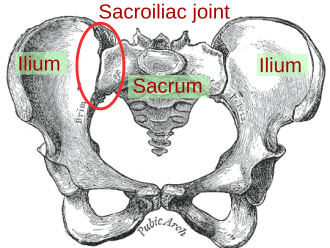
- The shape of our skeleton – how our bones fit together. The SI joint is made up of the interface between the ilium (top of the hip bone) and the sacrum (base of the spine). These bones are meant to fit together, with the surfaces having bumps and grooves like a “lock and key” pattern. The male pelvis tends to be more stable than female pelvis (which is why women experience SIJD at higher rates, although men definitely do experience it too).
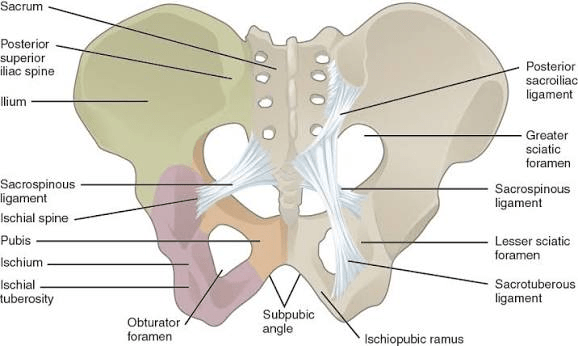
- Ligaments -the bands of connective tissue that attach each bone to the next. These can be sprained, and their integrity can vary due to hormone fluctuations, as well as genetics (in the case of genetic hypermobility disorders).
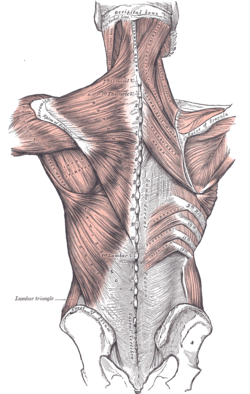
- Fascia – we have a sheet of connective tissue that stretches across our whole lower back, called the thoracolumbar fascia. It’s meant to act as a brace, and protects our spine and pelvis. (Note: some people believe fascia has active stabilization properties – we’ll have to get into that in more detail in a future post!).
Active Stabilization
Active stabilization strategies are processes that occur in the moment and require energy, based on feedback from our nervous system as it responds to the world around us.
The two main factors here are:
- Our muscles – how strong are they? How able are they to support the joint when we move, sit, lie down, breathe?
When our ligaments are sprained, having strong muscles around the joint can help to take the pressure off of them, and help pick up the slack when they’re no longer able to fully do their job.
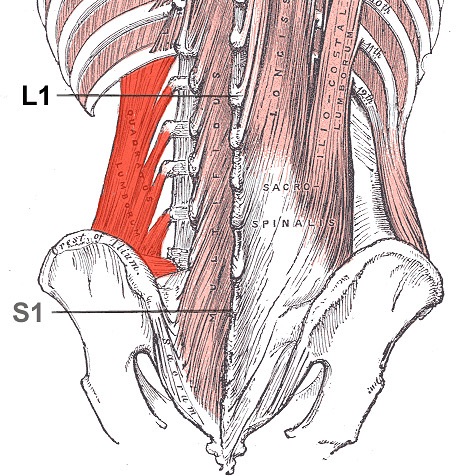
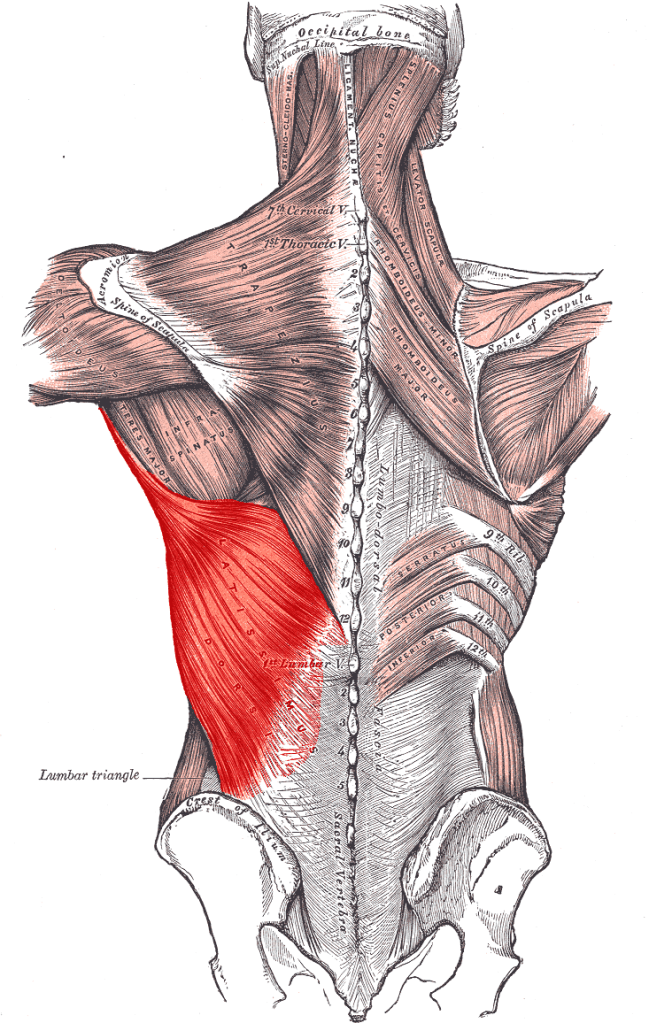
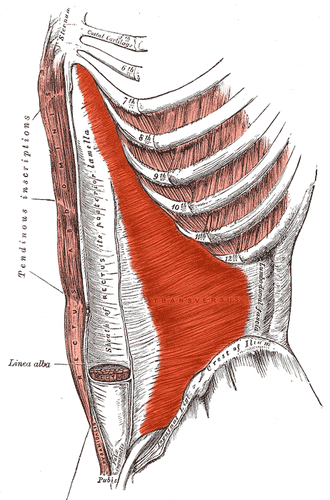
Muscle groups like the glutes, the core (including the transverse abdominis muscle), and the lattisimus dorsi can all help to play a role in keeping our SI joints stable.
- Our nervous system – how well does it coordinate our movements? Do our muscles work together, as they’re supposed to?
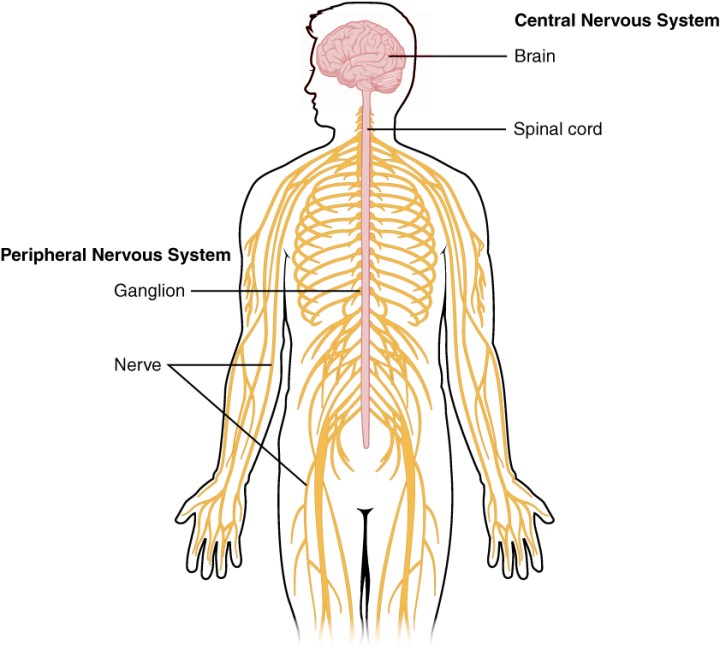
True stability is not just about how strong your muscles are- it’s also about nervous system control. What happens when you move? Do your muscles fire appropriately? Does one muscle overpower another, or do they work together in a balanced way?
Many rehab programs get this last part, especially, wrong.
Traditional PT programs will focus on making a patient’s muscles stronger. It’s basically assuming that you can take all of these smaller parts individually, make each one better, and then have them add up to a better whole.
But what I found is that there’s more to it. To truly become stable, you need more than to just have these individual parts each working well on their own.
It’s about building a system.
If you have SI joint dysfunction and your joints are moving out of alignment, it means the ligaments that are meant to hold the joint in place have been sprained.
This means we have to look at the other parts of our stabilization systems, and see what we can improve.
We can’t really change our passive stabilization systems (with the exception of treatments like prolotherapy or PRP, which are meant to strengthen the ligaments. What I’ve seen from my clients’ experiences is that they can sometimes be helpful, but positive results aren’t guaranteed).
So under normal circumstances, without medical intervention, we can’t modify our passive stabilization system. What we can do is modify our active stabilization system – our muscles and nervous system.





One of my first amazing hikes, when I began to figure all this out.
Communication, communication!
Research has shown that sometimes, following an injury, the communication pathway between our nervous system and stabilizer muscles can become inhibited. Our brain stops being able to communicate with these muscles as well.
The good hews it that there are ways to retrain this communication pathway, and help get it firing properly again.
The goal is not to need adjustments forever (although, again, they are very important in the moment if the joint is out of alignment). Rather, the long-term goal is to get back to the stability that you had before you developed SIJD, before the ligaments were injured.
I struggled for a long time, not having answers. Now, I’m here to let you know: you can get out of the cycle of needing constant adjustments to realign the joint.
Your body was stable before, and it can become stable again. You need to look at the things you can change, and move forward from there.
2026 Update:
I am turning my SI Joint Stabilization System ideas into a course. I love, love, love offering coaching sessions (and I’m happy to talk with you anytime!). But I want to add something else, so that you have a place to log back into after our session, or between sessions, and have a safe place to see a road map for moving forward.
If you’re interested in getting updates on the course specifically, you can sign up for email updates here! I may reach out to ask more about what specifically you’re interested in learning about, or to invite you to be a beta tester 🙂
Thank you for coming along for this ride! I’ve been so grateful to have you all here!


Hi Christy. I am glad to see that you are still sharing your wisdom about SI instability and stability with others. I was fortunate to find that four separate sessions of prolotherapy combined with correct muscle strength strengthening helped tremendously to keep my SI joint stable for four years until last August when I was rear ended on a toll road (long story) and not only was my car a total loss, but my SI joint got destabilized again, going out just one or two days after being adjuste, continuously. so I went through four more sessions of prolotherapy and muscle strengthening and have now remained stabilized for three months. I just thought you might want to share with your client helpful prolotherapy can be for some people
LikeLike
Hi Barbara, nice to hear from you! I’m so sorry to hear you went through that, but glad you found a way back to baseline again.
Re: prolotherapy – yes definitely, thank you for sharing your experience. Originally, I’d had a bit of a longer section in here on that, but took it out as I was afraid the post was getting too long.
From what I’ve seen working with clients, treatments like prolo and PRP can absolutely make a big difference, as in your story. I’ve also seen people get no results from them, or also sometimes end up regretting having them done, as they can stir up a lot of inflammation and people end up having to take time off from their strengthening exercises, and feel as though they’ve lost progress. So it’s hard to know what an individual person’s results will be.
One thing I do feel comfortable saying is that a person will likely increase their odds of success (or bouncing back more quickly, from a possible bad reaction) if they’re able to get as many of the other pieces in place beforehand. Things like realigning the joint (ideally in a gentle way) and the types of strengthening/stabilizing exercises I talk about here. I like to recommend these as a first line approach, as they are lower risk.
But absolutely, sometimes the regenerative medicine approach can help to shift things forward. I’m so glad that you have a success story to share!
LikeLike