
Hey everyone,
From time to time, I like to check up on current research, and see what’s new in the world of physical rehabilitation. And I just came across this fascinating exercise trial, which lined up with a lot of my own discoveries.
In this trial, physiotherapists in India tested 3 different exercise therapies for low back pain. They divided patients into 3 regroups. One group was instructed in specific exercises for lumbo-pelvic stabilization (similar to the exercises I used in my recovery).
The second group was instructed in a form of exercises called dynamic strengthening, emphasizing certain muscles such as the hip flexors. The third group was instructed in Pilates.
And while patients in all three groups experienced improvements over time, it was the lumbopelvic strengthening group that had the biggest improvements.
This is completely consistent with my own experience, and what I teach my clients.
If you’re struggling with SIJD, you’ll know that there are tons of different approaches to core exercise out there. I learn about new approaches every day from my clients.
Unfortunately, in spite of the many different names and schools of thought… a lot of these techniques don’t seem to do very much at all.
And once you factor in the fact that many people with SIJD have sprained SI joint ligaments, you’ll see why, often, so many of these approaches can actually make things worse.
The good news: We don’t need to do a million different things. We just need to target the root cause.
Over the course of my journey, I had to try multiple rounds of physical therapy – not to mention chiropractic, massage therapy, – you name it. I tried just about every approach out there, even things I found myself on Youtube. Eventually, I put together a protocol that worked for me, building from the snippets of wisdom I gained along the way.
What I found is that, surprisingly, some of the simplest and most gentle core training exercises are actually the most powerful.
I’d say my experience was actually pretty similar to the trial. I also found that lumbo-pelvic stability exercises gave me the most bank for my buck.
Ironically, it turned out that the muscles that had the biggest impact on stability could actually be activated while putting the least amount of pressure on the spine and pelvis.
What is lumbopelvic stability?
When we talk about lumbopelvic stability, we’re talking about improving the control our muscles (and nervous system) have over the individual joints of our pelvis, and between each vertebrae of the spine.
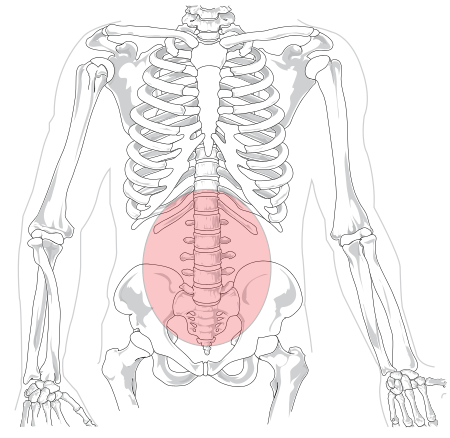
Although, for the purposes of this blog, I mainly focus on the SI joint, it’s important to note that really, the pelvis and lumbar spine operate as one larger unit. The same muscles that stabilize each segment of the spine also stabilize the SI joints.
So at the end of the day, whether we’re stabilizing the pelvis or the lumbar spine- it’s all part of the same continuum.
Local Muscles
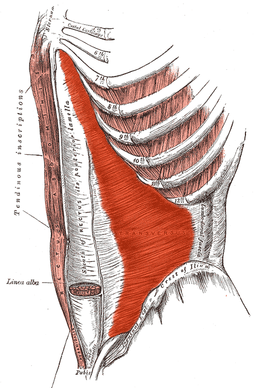
Lumbopelvic stability exercises target what we call “local” muscles. These muscles are often the deepest, and the closest to the joints they’re stabilizing. They also tend to be smaller (but not always) and are primarily made up of what we call “slow-twitch” fibers.

Global Muscles
By contrast, people often go to PT and are given exercises to strengthen the “global” muscular system. Strengthening these muscles isn’t necessarily bad, per se – it’s just about the order in which you do things.
Global muscles tend to be larger, and more powerful, and fatigue quickly. These are the muscles you’d be using if you needed to generate a lot of force at one time, like if you were lifting weights, or swinging a baseball bat as hard as you could. They move our body through space, but they do not play as direct of a role in stabilizing our individual joints. Global muscles have a job to do- and then they’re done.

That’s why, if you go to PT and focus on the global muscles with bunch of crunches, squats or leg lifts, you’ll be putting a good degree of force on your SI joints – but you won’t be training that internal stabilization system.
There is a better way.
So many of the various approaches out there don’t take our sprained ligaments into account. If your SI joint is moving out of alignment, it means your ligaments have sprained – and we’ve absolutely got to allow them to heal, as best we can.

Luckily, it turns out that the local stabilizers can be activated in incredibly gentle ways.
If you’re navigating SI joint dysfunction, you don’t have to push through exercises that hurt you.
When we activate local muscles, it can be very specific. It’s not about brute force — it’s about how well your brain is communicating with the muscles. And this is something you can train in a very delicate manner – and still get powerful results.
Targeting the root cause
That’s why the results of this study made total sense to me.
I’d say that, on average, the results are consistent with what I learned from my own experience, and what I’ve seen from talking to hundreds of people.
Some people do benefit from generalized strengthening. Some people benefit from Pilates.
Personally, I absolutely had initial improvements in my baseline from more generalized strengthening. But then I plateaued – and it was only by getting more specific in my training that I recovered.
Basically, the more precise and direct your exercises are, in specifically targeting the muscles that stabilize your joints, the better the results you’re going to get.
Moving forward

I’m working on a larger educational resource to share my exercises and other key concepts I’ve learned (still deciding whether it will be a book or a course!).
For now, if you want to skip the line, you can also book a coaching session to learn more. We’ll make sense out of everything you’re going through, and I’ll teach you my top strategies that got me from hobbling to hiking.
Talk soon!
 My Sacroiliac Joint Saga